
Our Pipeline
CB-001 — from target to therapy
| Program | Target | Discovery | Pre-clinical | Phase I | Phase II | Phase III |
|---|---|---|---|---|---|---|
| CB-001 | Neuronopathic Gaucher Disease (Type II and III) | |||||
| GBA-Parkinson’s Disease |
CB-001 Program Overview
CB-001 is a pre-clinical stage program focused on neuronopathic Gaucher disease and GBA-Parkinson’s, addressing significant unmet medical need. The program aims to address disease progression at its molecular root cause.
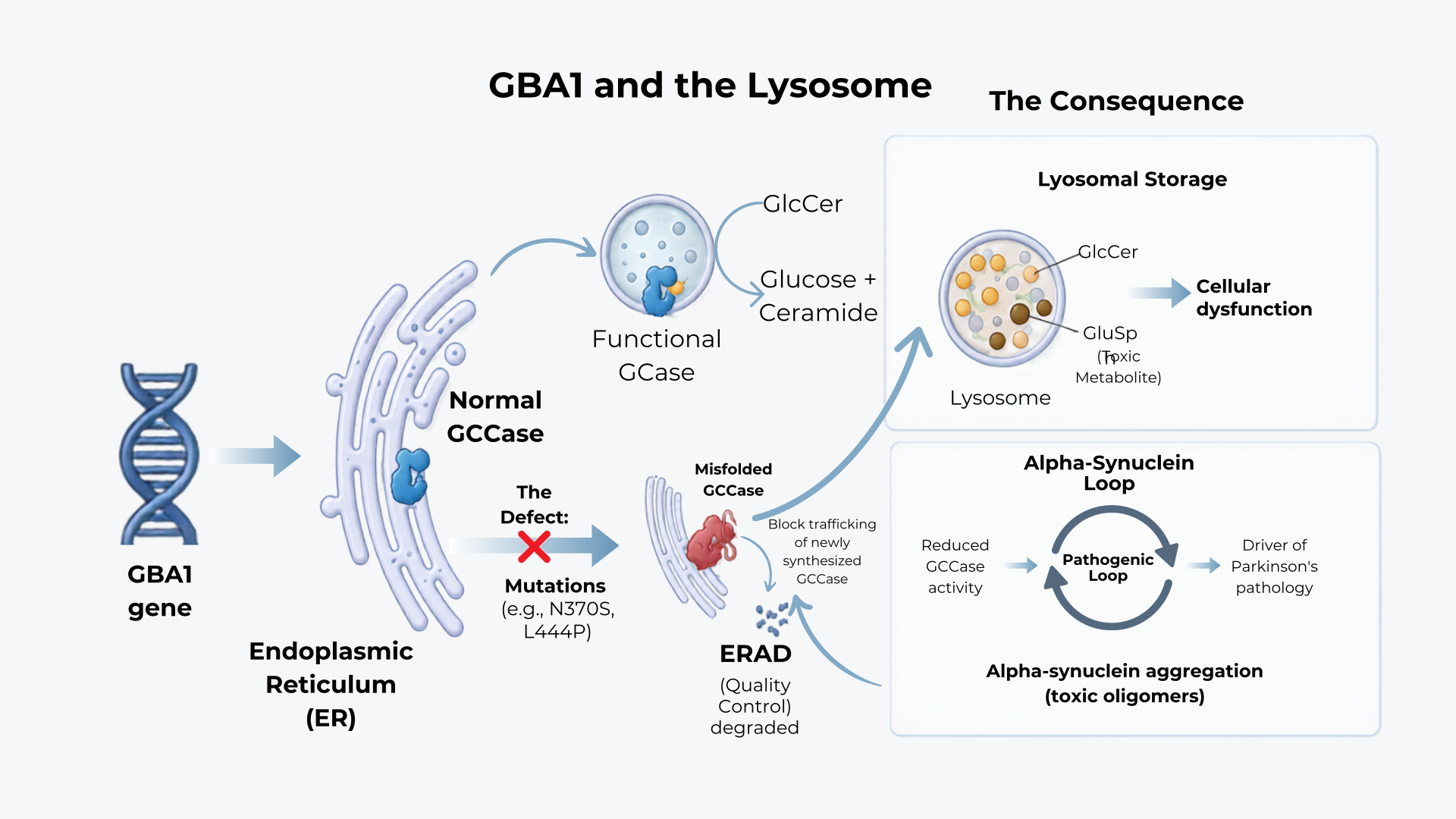
Gaucher is a protein folding disease with deep biological connections to Parkinson’s
GBA1 mutations produce misfolded GCase protein that is degraded before reaching the lysosome. The resulting loss of enzyme activity drives both lysosomal storage dysfunction and the alpha-synuclein aggregation loop implicated in Parkinson’s pathology.
The reality for Gaucher and Parkinson’s patients reveals an urgent unmet need
No treatments exist for neuronopathic GD2 or GD3 (several hundred US patients each). GD2 patients die in infancy; GD3 patients can live into midlife with ERT but face inevitable cognitive decline.
ERT: enzyme replacement therapy. Source: coherentmarketinsights.com, Gaucher Disease Treatment Market, Dec 2025.
A non-inhibitory small molecule chaperone built for CNS efficacy and convenience
CB-001 binds an allosteric site to stabilize mutant GCase without inhibiting its active site, restoring proper protein folding and function.
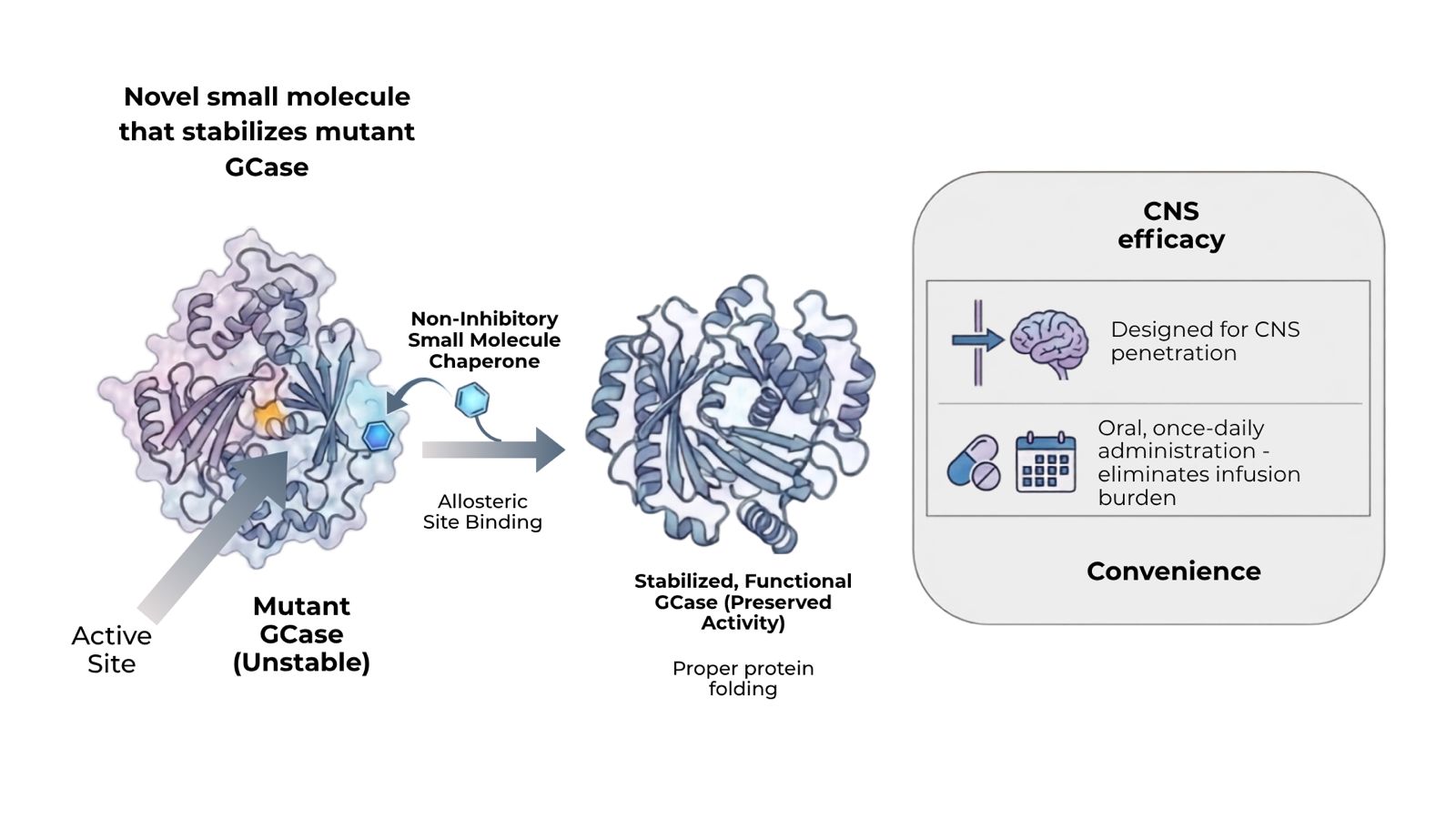
Designed for CNS penetration
Built to cross the blood-brain barrier and address neuronopathic disease, not just visceral symptoms.
Oral, once-daily administration
Eliminates the biweekly infusion burden of current enzyme replacement therapy.
Our Pipeline
CB-001 — from target to therapy
| Program | Target | Discovery | Pre-clinical | Phase I | Phase II | Phase III |
|---|---|---|---|---|---|---|
| CB-001 | Neuronopathic Gaucher Disease (Type II and III) | |||||
| GBA-Parkinson’s Disease |
CB-001 Program Overview
CB-001 is a pre-clinical stage program focused on neuronopathic Gaucher disease and GBA-Parkinson’s, addressing significant unmet medical need. The program aims to address disease progression at its molecular root cause.
Gaucher is a protein folding disease with deep biological connections to Parkinson’s
GBA1 mutations produce misfolded GCase protein that is degraded before reaching the lysosome. The resulting loss of enzyme activity drives both lysosomal storage dysfunction and the alpha-synuclein aggregation loop implicated in Parkinson’s pathology.
The reality for Gaucher and Parkinson’s patients reveals an urgent unmet need
There are currently no FDA-approved treatments for neuronopathic (Types 2 and 3) Gaucher disease.
ERT: enzyme replacement therapy. Source: coherentmarketinsights.com, Gaucher Disease Treatment Market, Dec 2025.
A non-inhibitory small molecule chaperone built for CNS efficacy and convenience
CB-001 binds an allosteric site to stabilize mutant GCase without inhibiting its active site, restoring proper protein folding and function.
Designed for CNS penetration
Built to cross the blood-brain barrier and address neuronopathic disease, not just visceral symptoms.
Oral, once-daily administration
Eliminates the biweekly infusion burden of current enzyme replacement therapy.
